
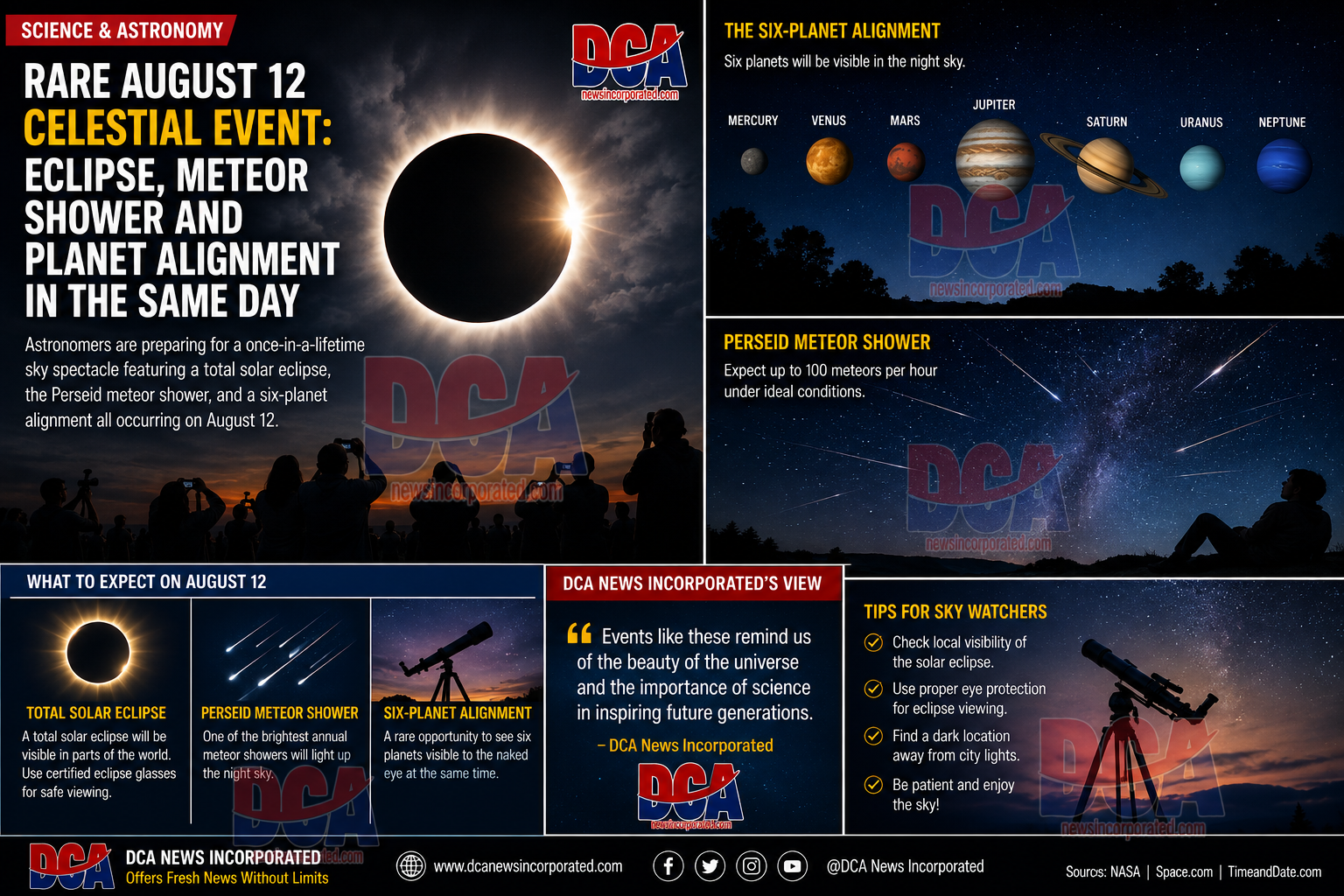
Astronomers and skywatchers around the world are preparing for one of the most anticipated astronomical events of the year. This will likely happen on the 12th August 2026. This is to showcase an extraordinary combination of celestial phenomena. The event features a total solar eclipse. This also involves the annual Perseid meteor shower, and a six-planet alignment. It is creating a remarkable day for astronomy enthusiasts.
Although each of these events can occur independently, seeing them associated with the same date has generated significant interest among scientists, educators, photographers, and amateur astronomers.

The Perseid meteor shower, widely known as one of the brightest annual meteor display. This is expected to produce dozens of meteors per hour under favorable viewing conditions. At the same time, observers in locations within the eclipse’s path may witness a total solar eclipse, while others may experience a partial eclipse depending on their geographic location.
Adding to the excitement, six planets are in expectation to appear in a visually striking alignment. While the planets remain separated by millions of kilometres in space. They are not physically bound together. They may appear bound together from Earth’s perspective because of their positions along the Solar System’s orbital plane.
For photographers and astronomy enthusiasts, August 12 offers an opportunity to capture unique images of the night sky. Experts recommend observing from locations with minimal light pollution and checking local weather forecasts for clear skies.Safe Viewing Is Essential
Astronomers emphasize that a solar eclipse should never be viewed directly without certified eclipse glasses or approved solar filters. Looking directly at the Sun without proper eye protection can cause permanent eye damage.
Meteor showers and planetary alignments, however, can generally be observed safely with the naked eye, although binoculars or telescopes may enhance the experience.
Scientific Perspective
Planetary alignments are visual effects created by Earth’s viewing angle rather than rare moments when planets form a perfectly straight line in space. Similarly, the Perseid meteor shower occurs each year as Earth passes through debris left behind by Comet Swift–Tuttle, causing tiny particles to burn brightly in Earth’s atmosphere.
These recurring astronomical events help scientists better understand orbital mechanics while inspiring future generations of researchers and engineers.
At DCA News Incorporated, we believe astronomy represents more than scientific observation—it reminds humanity of our shared place in the universe. Rare celestial events provide opportunities for education, innovation, and international scientific collaboration.
As global investment in space research continues to expand, public engagement with astronomy can encourage young people to pursue careers in science, technology, engineering, and mathematics (STEM). Governments, educational institutions, and research organizations should continue supporting public science outreach that makes astronomy accessible to communities worldwide. Events like the August 12 celestial display also demonstrate how science transcends borders. Whether viewed from Africa, Europe, Asia, the Americas, or Oceania, the night sky remains a shared heritage that unites humanity through curiosity and discovery.
What Skywatchers Should Know
- Check whether your location lies within the eclipse’s visibility path.
- Use only ISO-certified eclipse glasses for solar viewing.
- Find a dark location away from city lights for the best meteor shower experience.
- Allow your eyes to adjust to darkness for at least 20 minutes.
- Use astronomy apps or star charts to help identify visible planets.